

AI Drug: Is Rentosertib a Miracle Solution for Reversing Aging by “4 Years”?

Written by Gab
Contents
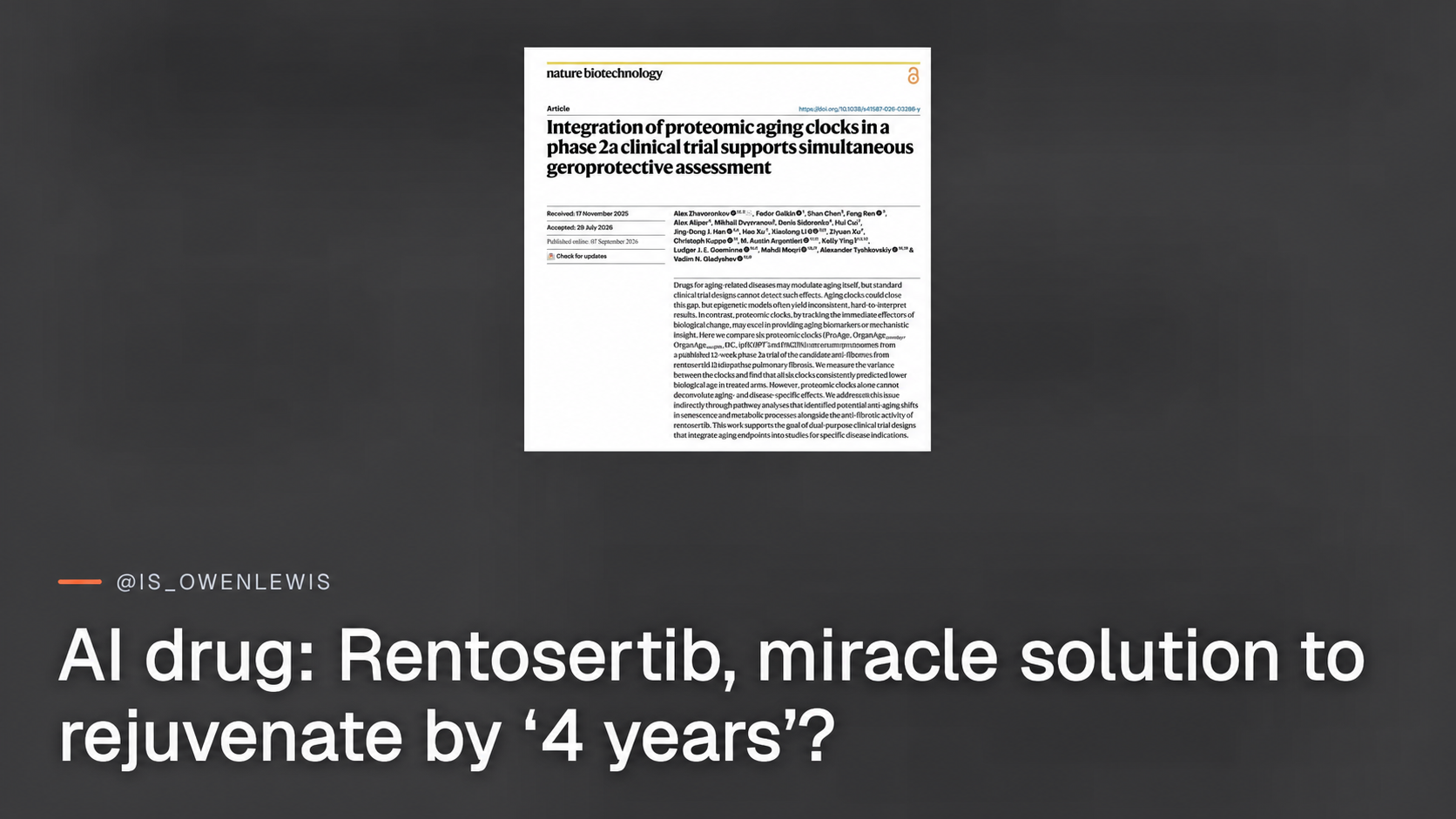
Can rentosertib really reverse human biological age by 3 to 4 years in just twelve weeks? That is the spectacular claim made by Owen Lewis (@is_OwenLewis) in a thread published on September 8: an AI-designed drug “reverses (not slows, reverses) biological age in humans by 3-4 years.” His message emphasizes three words designed to make an impact: “Not mice, not monkeys. Humans.”
The thread does not stop at this announcement. In his next three posts, Owen Lewis adds, in turn, “More 👇,” then “Not slower. Younger.,” and finally, “Huge news is an understatement.” His argument is therefore clear: he is presenting not merely a change in a biomarker, but the beginning of actual human rejuvenation, made possible by the acceleration of medical research through AI.
This interpretation, however, goes further than the source he is amplifying. The original post by Derya Unutmaz, MD (@DeryaTR_), published on September 7, provides the technical details missing from the announcement: the name of the drug, rentosertib, its developer, Insilico Medicine, the 12-week duration, the six aging clocks, and the estimate of 3 to 4 years.
Derya Unutmaz states that rentosertib, a drug candidate for idiopathic pulmonary fibrosis, led to lower scores across six biological clocks developed by separate teams. His wording is also highly enthusiastic, but it remains focused on the clocks and on participants whose biological measurements appear younger. Owen Lewis turns this finding into a more categorical claim: a drug “reverses” biological age in humans.
The key point is this: a decrease in an aging clock does not automatically mean that a person has become clinically younger.
What the source post actually claims
In his post, @DeryaTR_ writes:
"Six different aging clocks, developed by six independent groups, all showed reversal after just 12 weeks of treatment" @DeryaTR_
The data come from a phase 2a trial involving approximately 42 to 43 patients with IPF, or idiopathic pulmonary fibrosis. The figure shared by Owen Lewis describes four groups: 30 mg once daily with 11 participants, 30 mg twice daily with 11 participants, 60 mg once daily with 9 participants, and a placebo group with 11 participants. Samples were collected at baseline, then at weeks 2, 4, and 12.
The illustration is important because it serves as a reminder that the result comes from a short trial conducted in patients with a specific disease, using repeated proteomic analyses. It does not describe a trial designed to demonstrate an effect on longevity.
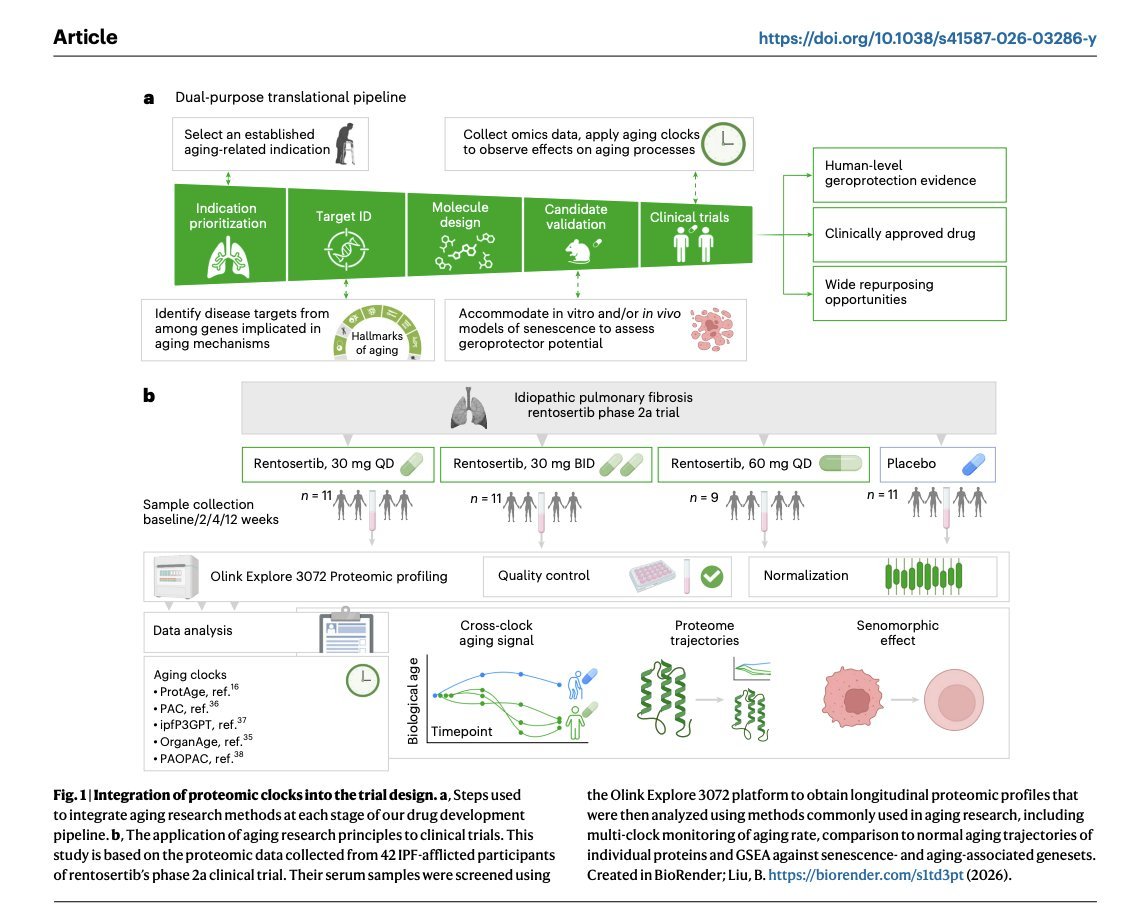
The six tools cited are proteomic clocks, including ProtAge, two versions of OrganAge, PAC, ipfP3GPT, and PAOPAC. They use blood protein profiles to estimate age, risk, or a physiological state associated with aging.
The strongest signal reportedly appeared around week 4, particularly with the 30 mg twice-daily regimen. According to the analyses shared by Insilico Medicine, the chronological clocks suggest a decrease of approximately 2.7 to 3.5 years, often publicly rounded to 3 to 4 years, with a larger result for one specific clock.
This is a potentially interesting result. Nevertheless, its interpretation must remain proportionate to what was actually measured.
An aging clock does not measure age literally
An aging clock is neither a biological watch nor a counter tracking the number of years a person has lived. It is a statistical model.
The principle is simple, even if the underlying biology is not. Researchers measure hundreds or thousands of biological variables, then train an algorithm to recognize signatures commonly associated with age, age-related diseases, mortality, or certain physiological states.
These signatures may include:
- DNA methylation, in the case of epigenetic age clocks;
- plasma proteins, in the case of proteomic clocks;
- metabolic, inflammatory, or immune measurements;
- clinical variables associated with the risk of disease or mortality.
When an aging clock decreases, it means that a set of biomarkers more closely resembles that of a statistically younger population, or a population at lower risk according to the model used.
By definition, this does not mean that all tissues have become younger, that physical abilities have improved, that diseases are receding in a lasting way, or that lifespan is increasing.
This is precisely the objection raised by Ramez Naam (@ramez) in Owen Lewis’s thread:
"Aging clocks are not biological age. No strong evidence that this actually makes people younger in the sense of extending lifespan or increasing overall health or fitness in a manner commensurate with these claims." @ramez
This response does not necessarily claim that the decrease in the aging clock is false. Rather, it challenges what can be inferred from it. Between “a model’s score decreased” and “the body became younger,” there is a causal chain that remains to be demonstrated.
Owen Lewis did not respond to this objection. Yet it strikes at the very heart of the claim: the relationship between a biomarker and a tangible human benefit.
Six clocks, yes. Six independent pieces of evidence, not necessarily.
Derya Unutmaz’s phrase, “six different aging clocks, developed by six independent groups,” gives the impression of particularly robust validation. The tools were indeed developed by separate groups, including teams affiliated with Harvard, Oxford, Peking University, and Insilico Medicine.
However, the independence of the teams that created the tools does not mean that the six measurements are statistically independent of one another.
Under Derya Unutmaz’s original post, Boris Power (@BorisMPower) summarizes this methodological criticism:
"But those 6 clocks are highly correlated and it seems like one protein affects the prediction the most, LTBP2. I think if we can show lasting improvement in healthy people, that would be a much stronger indicator that we’re on the right path" @BorisMPower
Derya Unutmaz’s response is brief:
"Yes but gotta start somewhere, Astra will help accelerating this!" @DeryaTR_
The two positions are not truly incompatible. Yes, we have to start somewhere. But Boris Power’s argument explains why six clocks moving in the same direction should not be presented as six independent replications of rejuvenation.
The LTBP2 case: collective signal or dominant protein?
The name LTBP2, which stands for latent transforming growth factor beta binding protein 2, has become central to the discussion. According to the criticism relayed by Boris Power, this protein may carry a great deal of weight in some predictions.
Why does this matter?
If several clocks use, directly or indirectly, proteins related to the same biological pathways, they may respond together to the same variation. In that case, they do not provide six separate confirmations, but rather six similar readings of the same biological change.
This does not make the result useless. On the contrary, a strong modulation of LTBP2 could be biologically relevant in a fibrotic disease. However, two hypotheses must be distinguished:
- Rentosertib improves pathological mechanisms associated with IPF, thereby normalizing a proteomic signal.
- Rentosertib slows or reverses general mechanisms of aging, including in people without pulmonary fibrosis.
The 12-week trial does not yet make it possible to distinguish between these two interpretations.
To strengthen the evidence, researchers will need to show that the signal persists when LTBP2 is removed from the analyses, that each clock retains an effect of its own, and that the results can be replicated in other cohorts.
The central bias: the participants had idiopathic pulmonary fibrosis
The study population did not consist of healthy adults seeking to optimize their longevity. It consisted of patients with idiopathic pulmonary fibrosis, a progressive lung disease characterized by abnormal scarring of lung tissue.
This point profoundly changes how the result should be interpreted.
IPF can alter inflammation, cellular signaling, metabolism, immunity, and circulating proteins. These are precisely the types of variables that may feed into proteomic or epigenetic clocks. A severe disease can therefore make a patient appear biologically older in some models.
This is what Joel Sercel, PhD (@JoelSercel) points out:
"No.... Epigenetic age is NOT the same as aging, and the disease this drug treats accelerates epigenetic age, so these subjects would show as older than their chronological age on epigenetic clocks before treatment. The drug helps with the lung disease, so it would correct the mismatch between bogus epigenetic clock aging and actual age. This is noise." @JoelSercel
Owen Lewis replied:
"Depends what you think of the epigenetic theory of aging I guess. Personally, I think it's a piece of a larger puzzle, probably not the sole cause." @is_OwenLewis
This response acknowledges a useful theoretical uncertainty: epigenetic and proteomic signatures may be an important piece of the aging puzzle without being its sole cause. However, it does not address the population bias raised by Joel Sercel.
Treating a disease that raises a clock’s reading can bring that reading back down without demonstrating that the entire body has grown younger.
This is why a study conducted in patients with IPF cannot, on its own, justify a claim for healthy older adults. Responding to a reader, Derya Unutmaz says he believes the result “should translate to older people without IPF.” This is a working hypothesis, not an established clinical finding.
Estimated biological age, healthspan, and lifespan: three levels of evidence
The debate often suffers from a shift between three very different outcomes.
-
Biological age estimated using biomarkers
This is what was measured here. A clock generates a score based on proteins, epigenetic markers, or other variables. -
Healthspan, or the length of time spent in good health
It is measured using functional endpoints: respiratory capacity, mobility, strength, cognition, independence, symptoms, hospitalizations, quality of life, and disease incidence. -
Actual longevity
This requires a demonstrated effect on mortality or, failing that, very long-term follow-up using clinical endpoints that are strongly predictive of survival.
Owen Lewis’s thread quickly moves from the first level to the third. Yet perhaps the most accurate comment in his discussion is the one calling for clinical endpoints:
"Wake me when it actually extend life or health span." @Klosaro
Owen Lewis replies:
"This is hopefully a big step in that very direction." @is_OwenLewis
The key word is “hopefully.” It sums up the actual state of knowledge fairly well. The result may represent an early signal pointing toward better health, but it does not yet prove an improvement in healthspan, much less a longer life.
What phase 3 does and does not allow us to conclude
Rentosertib is a TNIK inhibitor developed by Insilico Medicine, the company founded by Alex Zhavoronkov and known for its use of AI in drug discovery. The candidate has indeed entered phase 3 for IPF, making it a program worth following closely.
The phase 3 trial in question involves approximately 320 patients at 47 centers in China, with 52 weeks of follow-up. Its primary endpoint is the decline in forced vital capacity, or FVC, a measure of lung function. This is exactly the type of endpoint that matters for rentosertib’s medical indication.
But a phase 3 trial does not automatically turn the drug into an approved, available, or validated anti-aging treatment.
It primarily indicates that the program is sufficiently advanced to test its efficacy and safety against idiopathic pulmonary fibrosis. Aging clocks remain an exploratory outcome, not the primary measure of clinical benefit.
Several questions remain open:
- Were the clock analyses prespecified before the trial or explored afterward?
- Are changes in scores associated with better FVC, fewer symptoms, or a better quality of life?
- Does the benefit persist after treatment is discontinued?
- Does the signal remain after several months or years of follow-up?
- What happens in an older cohort without IPF?
- Do the results remain robust without LTBP2 or when the clocks are analyzed separately?
A revealing week for AI-driven biology
The debate comes amid a series of developments highly favorable to the promises of biomedical AI. That same week, DeepMind unveiled AlphaGenome Atlas, designed to map the predicted molecular impact of approximately 9 billion human genetic variants. Results in mice also linked semaglutide to an increase in median lifespan, from 742 to 834 days, with reported cognitive and metabolic benefits.
At the same time, medical models continue to advance, with announcements surrounding OpenEvidence’s Darwin and GPT-6 Astra. These developments point to a genuine acceleration in scientific tools.
However, faster tools do not eliminate the need to respect the hierarchy of evidence. A promising proteomic prediction, an effect in animals, and a lasting clinical benefit in humans are not interchangeable.
Key takeaways
The rentosertib biological age signal warrants attention: seeing several proteomic clocks move in the same direction after 12 weeks in patients with IPF is an interesting finding, especially for a drug originating from Insilico Medicine’s program and now in phase 3.
But @ramez, @JoelSercel, and @BorisMPower are right on the underlying science. The evidence does not show that rentosertib reverses overall human aging, increases healthspan, or extends lifespan.
Derya Unutmaz’s wording, centered on clock scores, is already ambitious. Owen Lewis’s version, with “reverses” and “Humans,” removes an essential methodological distinction between a biomarker and a clinical benefit.
The scientifically accurate headline is therefore not “humans became four years younger.” It would be more accurately stated as: an anti-fibrotic drug altered several proteomic estimates of biological age in patients with IPF. It is less viral, but far more accurate.
The next useful step will not simply be to replicate a clock score. It will be necessary to demonstrate, over time, in diverse populations, and ideally also in people without IPF, a link between this biological signal, improved function, lower morbidity, and increased survival.