

DeepSeek V4.1 Flash: China’s New AI Price-Performance Revolution

Written by Gab
Contents
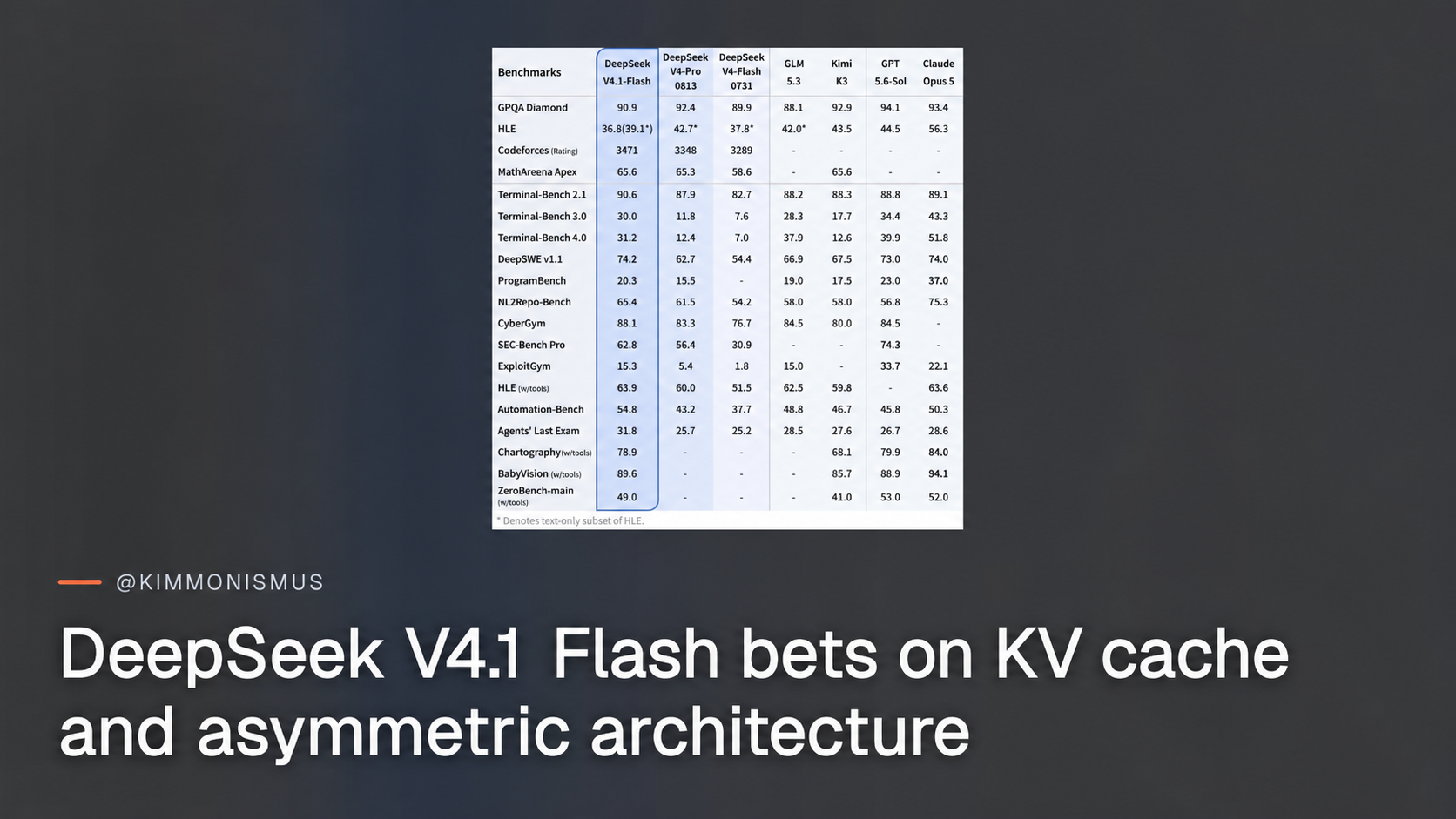
DeepSeek V4.1 Flash is presented by @kimmonismus as a particularly rapid evolution, six weeks after July’s V4-Flash update. His post highlights the key figures: a Causal Encoder Decoder architecture, 552 billion MoE parameters, with 8 billion active during input processing and 16 billion during generation, as well as a KV cache reduced to one-quarter of the HBM and one-eighth of the SSD storage required by the previous generation. He adds that DeepSeek now reportedly outperforms DeepSeek V4 Pro in capability, cost, and speed, and that V4 Pro traffic is to be temporarily routed to V4.1 Flash starting September 14.
This interpretation is broadly faithful to the announcement, but it focuses primarily on the pace of releases and the product leap. The official thread provides a more complete picture: the gains are attributed not only to the architecture, but also to new pre-training methods and larger-scale RL post-training. Most importantly, behind the messaging around a “smarter, faster, more efficient” Flash model, the most operationally significant change concerns the memory required for long-context inference, a critical issue for AI agents.
The chart shared by @kimmonismus also shows a less uniform reality than the marketing narrative suggests: DeepSeek V4.1 Flash is competitive across several evaluations, but does not consistently outperform leading models on Terminal-Bench.
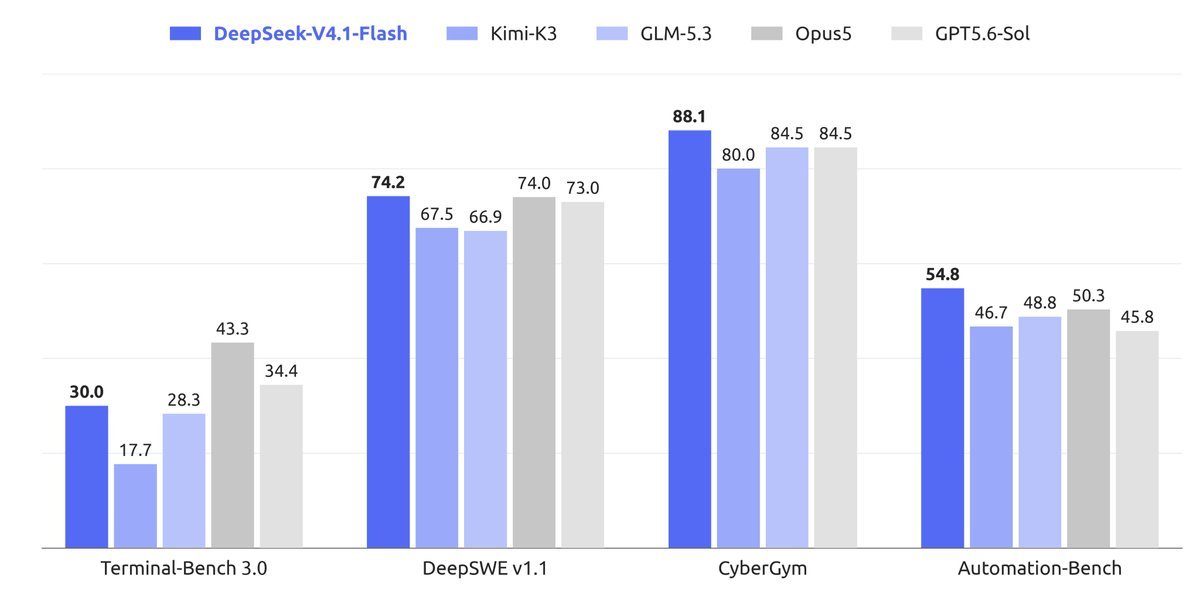
The post by @kimmonismus, published on September 10, explicitly draws on the thread from DeepSeek’s official account. This point is important: the figures, endpoint migration, and performance claims come first and foremost from the model’s developer, not from the analyst who summarized them.
Here is the source post, published by DeepSeek a few hours earlier:
The official thread: a new family, not just a Flash update
In its first post, @deepseek_ai presents V4.1 Flash as “the smallest model in our new architecture family,” with native visual understanding. The positioning is clear: Flash is no longer merely a lightweight variant, but the first model in a family designed for speed, throughput, and scalability.
The second part of the thread details the architecture. DeepSeek V4.1 Flash is based on a 552-billion-parameter MoE, but does not use the entire network at every step. According to DeepSeek, only 8 billion parameters are active during input processing, followed by 16 billion during generation.
This asymmetry lies at the heart of the Causal Encoder Decoder architecture. Context processing and new-token generation no longer have the same cost and do not use exactly the same resources. For use cases that require reading a large context before generating a relatively short response, this separation can improve the cost-performance ratio.
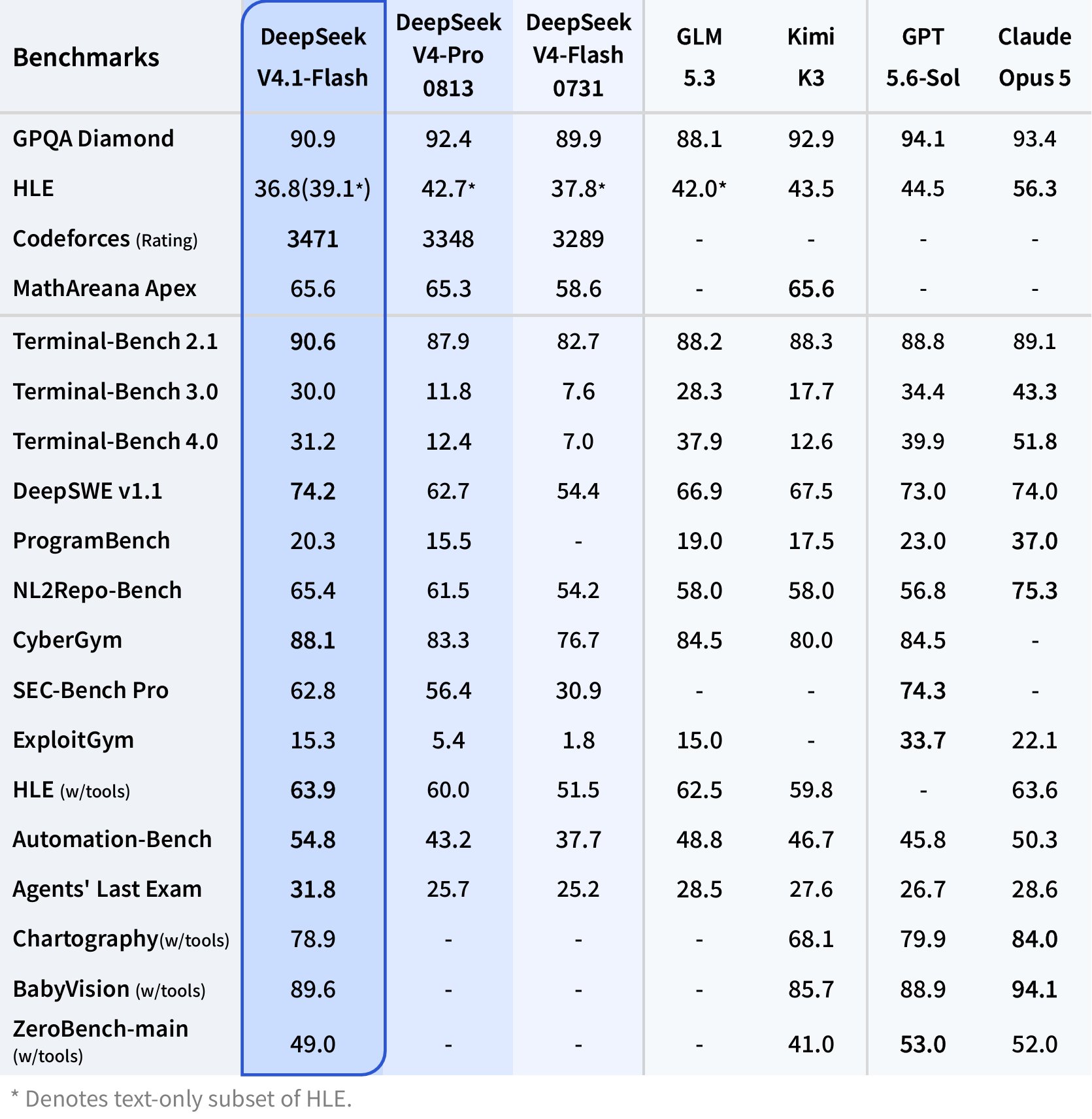
The official table compares V4.1 Flash with V4 Pro 0813, V4 Flash 0731, and several competitors. It notably reports scores of 30.0 on Terminal-Bench 3.0, 31.2 on Terminal-Bench 4.0, and 74.2 on DeepSWE v1.1 for V4.1 Flash.
Key DeepSeek V4.1 Flash benchmarks
| Benchmark | Reported V4.1 Flash score | Interpretation |
|---|---|---|
| Terminal-Bench 3.0 | 30.0 | V4.1 Flash outperforms GLM 5.3 in the official table. |
| Terminal-Bench 4.0 | 31.2 | The model remains behind GLM 5.3, which is listed at 37.9. |
| DeepSWE v1.1 | 74.2 | A result highlighted by DeepSeek for software engineering tasks. |
DeepSeek claims that its new pre-training methods, combined with more ambitious RL post-training, put the model ahead of flagship systems, including DeepSeek V4 Pro. This detail is important in relation to @kimmonismus’s summary: the architecture is central, but it does not by itself explain the reported scores.
The official wording is deliberately simple:
"Smaller KV cache. Bigger savings." @deepseek_ai
V4.1 Flash’s most tangible promise is therefore not necessarily a higher raw score, but significantly lower memory costs for long-running, repetitive workloads.
DeepSeek’s KV cache, the real lever for agents
The KV cache stores the representations needed to avoid recomputing the entire context for each generated token. This memory is essential for long conversations, tool-calling agents, coding workflows, iterative searches, and systems that retain an extensive history.
DeepSeek says that the V4.1 Flash cache now requires only:
- One-quarter of the HBM required by the previous generation.
- One-eighth of the SSD storage previously needed.
- Approximately 890 bytes per token of global cache, compared with 3,514 bytes for V4 Flash, according to the chart published by the company.
The official graphic shows a dramatic decrease since DeepSeek-V1: 389,120 bytes per token for V1, 48,068 for V3.2, 3,514 for V4 Flash, and then 890 for V4.1 Flash.
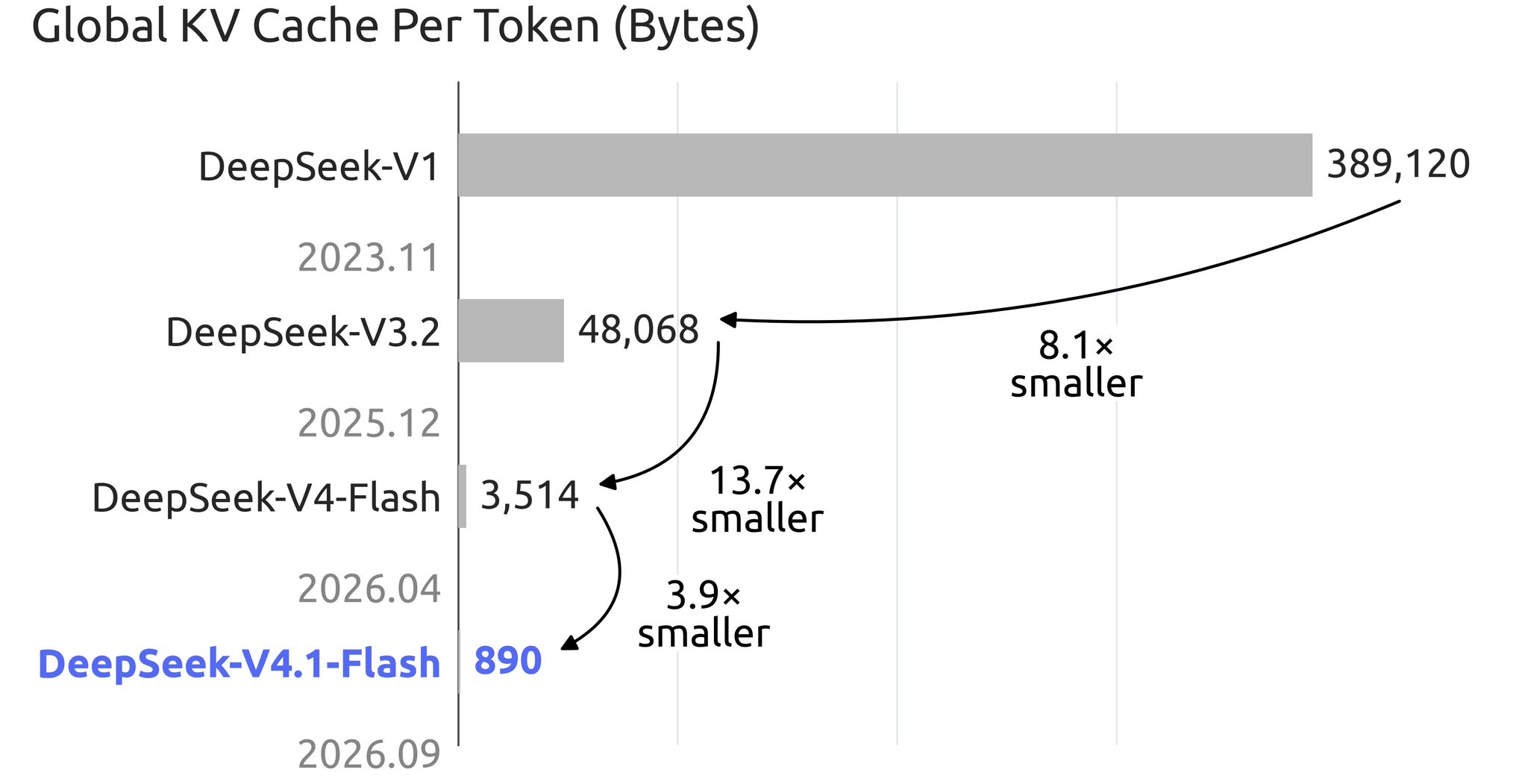
For an agent operator, this improvement may be more consequential than a marginal gap on a benchmark. Cache hits often account for a significant share of the bill when an agent frequently reuses a large context. Compressing this cache reduces both the pressure on GPU memory and the storage capacity required at scale.
This is precisely what @datachad points out in the replies to @kimmonismus's post:
"the kv-cache cut to a quarter of hbm is the one that matters for local inference" @datachad
The observation is correct, but it needs to be qualified. A more compact DeepSeek KV cache makes AI self-hosting more accessible for infrastructure that is already equipped for it. However, it does not turn a 552-billion-parameter MoE model into software that is easy to run on a personal computer.
DeepSeek indirectly acknowledges this when it refers to deployments on an entirely different scale:
"Planning a large-scale deployment with 2,000 GPUs + a storage cluster? Let’s talk." @deepseek_ai
The cache improvement significantly improves serving economics, but it does not eliminate the hardware barrier created by the model's size.
The model and its technical report are available via the DeepSeek-V4.1-Flash Hugging Face page and the DeepSeek V4.1 technical report. However, the material available in the thread does not make it possible to confirm the details about a “196B engram” mentioned by @UnslothAI in a reply. This figure should therefore not be treated as a verified specification without directly reviewing the technical report.
An API transition that makes Flash the default product
The announcement does more than promote a new model. It also reorganizes DeepSeek's product lineup.
The official thread states that:
- V4 Flash and V4 Flash Vision Exp are being retired.
- The old
deepseek-v4-flashanddeepseek-v4-flash-vision-expidentifiers are temporarily being redirected to V4.1 Flash to preserve compatibility. - Starting on September 14, 2026, at 04:00 UTC, requests intended for DeepSeek V4 Pro will also be routed to V4.1 Flash.
- This arrangement is expected to remain in place until V4.1 Pro launches.
- Requests migrated from V4 Pro will be billed at V4.1 Flash rates.
This decision goes far beyond a marketing comparison. DeepSeek is making V4.1 Flash its flagship API product even before V4.1 Pro arrives. For teams already using the API, the migration reduces the risk of immediate disruption. However, it does not eliminate the need to revalidate outputs, latency, tool calls, native vision, and the model's behavior in production.
@bygregorr sums up the problem from the perspective of application developers:
"Six weeks between architecture families is a short runway for API builders." @bygregorr
DeepSeek is addressing this with temporary compatibility and by routing the old identifiers. This is a pragmatic response in terms of service continuity, but it is not a guarantee of perfect functional equivalence. An agentic application that is sensitive to output formats, tool calls, or reasoning policies will still need to be retested.
DeepSeek's pricing table lists different per-million-token prices depending on the time of day. During off-peak hours, it lists $0.003 for cached input, $0.15 for uncached input, and $0.6 for output. During peak hours, these amounts rise to $0.006, $0.3, and $1.2, respectively.
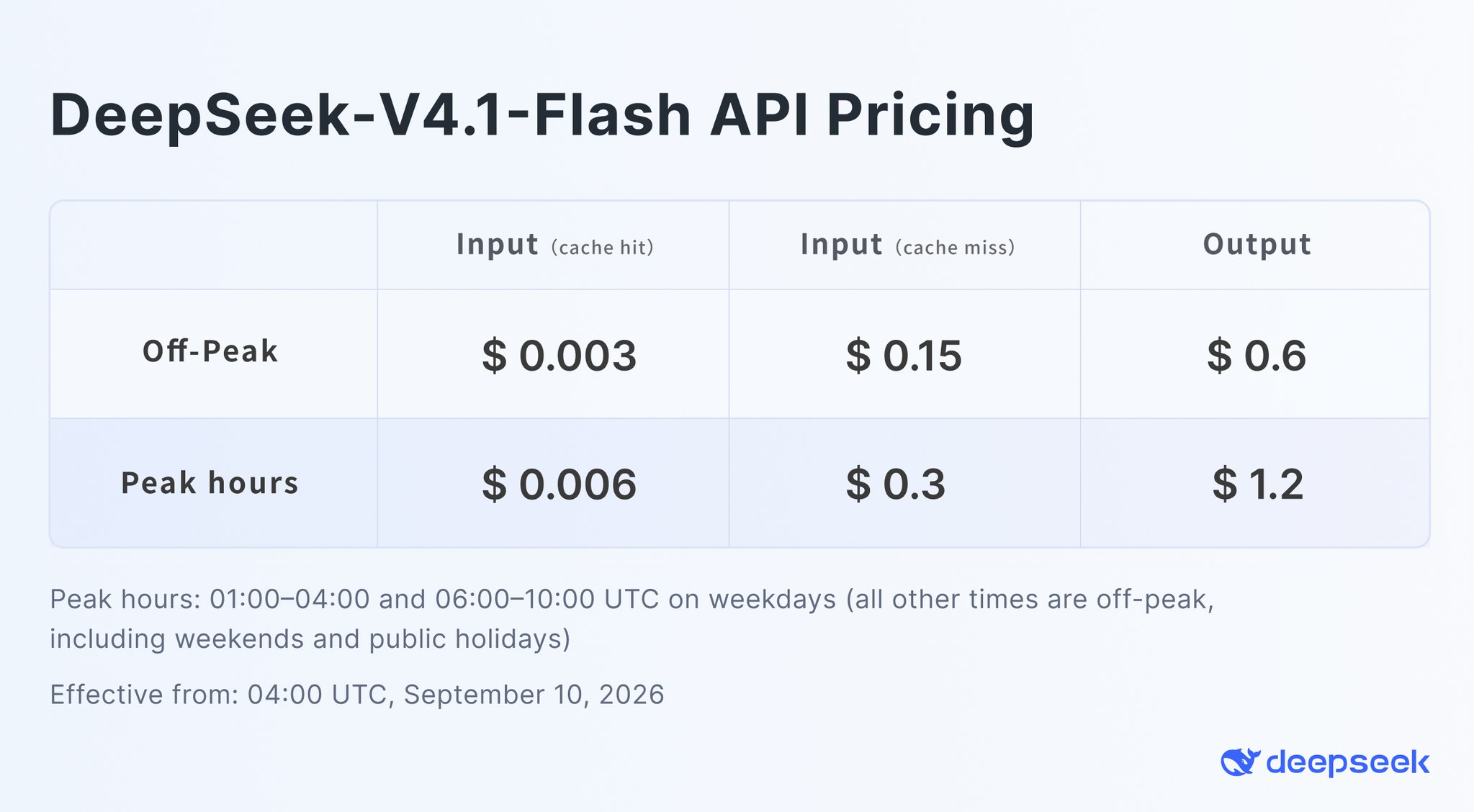
DeepSeek specifies that off-peak rates are 50% of peak rates. This pricing structure strengthens the economic appeal of flexible workloads, particularly batch processing, automated evaluations, and asynchronous agentic tasks.
A third-party post by @ns123abc, mentioned in the broader discussion, reports execution costs approximately 86 times lower per million tokens and throughput of 420 to 507 tokens per second. These figures may inform the debate, but they do not appear in the official thread provided. They should therefore be regarded as third-party claims dependent on the hardware, context length, quantization level, and workload tested, rather than as confirmed DeepSeek data.
Terminal-Bench: claimed dominance, but not a universal verdict
DeepSeek claims that “tests by multiple parties” place V4.1 Flash ahead of V4 Pro in performance, cost, speed, and total execution time. This claim may support its comparative positioning, but the thread does not provide sufficient documentation on the protocols, providers, inference settings, or exact composition of these tests.
The main point of contention concerns Terminal-Bench, a closely watched benchmark for evaluating computer-use and coding agent capabilities.
@Greg_GL_87 highlights an apparent inconsistency between two versions of the evaluation:
"the table has it losing Terminal-Bench 4.0 to GLM 5.3, 31.2 vs 37.9, but winning 3.0. weird split for two versions of the same eval" @Greg_GL_87
This criticism received no response in the thread. It is specific and important. The official table does indeed show 31.2 for V4.1 Flash on Terminal-Bench 4.0, while @Greg_GL_87 compares this score with GLM 5.3’s 37.9. At the same time, V4.1 Flash scores 30.0 on Terminal-Bench 3.0, where it outperforms GLM 5.3.
A model can beat V4 Pro on several metrics without being the best choice for every agentic coding task. Without a detailed protocol, it remains impossible to determine whether the gap between Terminal-Bench 3.0 and 4.0 stems from the tasks, environments, test parameters, or another methodological factor.
@kryptosopus raises a broader objection by comparing V4.1 Flash with Claude Opus 5:
"Native vision baked into the smallest model but it still loses Terminal-Bench to Opus5 by 13 points. Flash is clearly the "cheap and fast" play, not the frontier one. The scaling line at the bottom is the real tell here" @kryptosopus
This interpretation does not entirely contradict DeepSeek’s. V4.1 Flash may outperform DeepSeek V4 Pro according to several metrics selected by the company while still trailing Opus 5 on a specific agentic benchmark. The problem arises when a relative improvement within a product line is turned into a claim of overall supremacy.
Reactions: open-source enthusiasm, product caution, and questions about the future Pro version
Replies to the official thread are largely enthusiastic about the model’s openness and rapid integration. For example, @MrAhmadAwais says that V4.1 Flash is already available in his CommandCodeAI offering. @Presidentlin primarily praises DeepSeek’s contribution to the open-source ecosystem:
"Thank you again for moving Open Source forward" "As always oblig" "How high will your ceiling go?!!" @Presidentlin
The reply was accompanied by a manga panel that embodies this mix of fascination and challenge in response to DeepSeek’s pace.

@ParthM1001, meanwhile, sums up the mood with a culinary metaphor:
"The whale has cooked something beautiful again." @ParthM1001

Replies to @kimmonismus’s post focus more on the positioning of the product line. @elshayib_ believes the previous Pro version no longer serves a purpose:
"V4 pro kinda irrelevant now" @elshayib_
@kimmonismus replies:
"yeah, just waiting for another release of the pro version" @kimmonismus
This response is consistent with the official announcement: V4 Pro is indeed being temporarily phased out, but DeepSeek explicitly announces a future V4.1 Pro. Concluding that the entire Pro line is permanently obsolete therefore goes beyond the established facts.
The same question is raised by @RimasXYZ:
"if flash now beats v4-pro on capability, cost and speed, what is left for v4.1-pro to win on?" @RimasXYZ
The thread does not answer this question. It leaves the definition of the future Pro product entirely open: better quality on difficult tasks, enhanced reasoning capabilities, a longer context window, agentic reliability, or some other performance trade-off.
Causal Encoder-Decoder Architecture: What Changes Technically
@austinyuhao’s response, “welcome back encoder-decoder,” is brief but relevant. DeepSeek is not merely introducing cache compression; it is also reintroducing an architectural separation between the causal encoding path and the decoder.
"welcome back encoder-decoder" @austinyuhao
The diagram shared in the reply shows a twenty-layer Causal Encoder and a twenty-layer Decoder, for a network totaling forty layers. It also includes the MoE, CSA2, SWA, Vision Encoder, Text Embedding, Engram, DSpark, and Candidate Pool components.
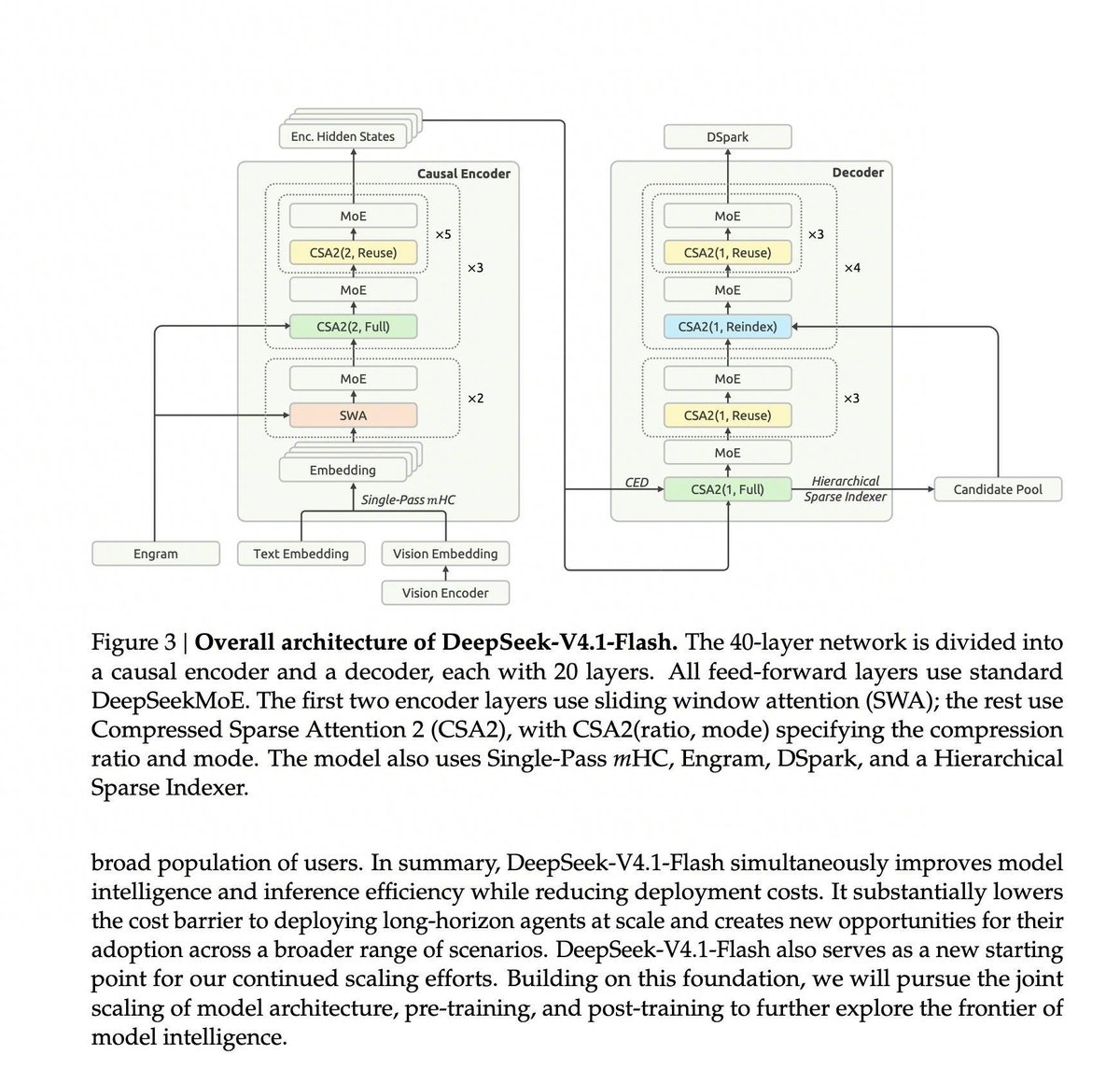
This organization explains why multimodal inference and the KV cache are interconnected. DeepSeek aims to support vision natively while keeping costs reasonable for long sequences. The promise is particularly attractive for agents that need to read documents, analyze interfaces, manipulate code, and maintain persistent working memory.
DeepSeek V4.1 Flash FAQ
How Many Parameters Are Active in DeepSeek V4.1 Flash?
DeepSeek has announced a MoE model with 552 billion parameters. Only 8 billion parameters would be active while processing the input, followed by 16 billion during generation.
Why Is DeepSeek’s KV Cache Important for AI Agents?
The KV cache retains representations of context that has already been processed. A more compact cache reduces GPU memory and storage requirements, which can lower the cost of long conversations, agents with tool calls, and workflows that frequently reuse the same context.
What Happens to DeepSeek V4 Pro Users?
Starting on September 14, 2026, at 04:00 UTC, requests intended for DeepSeek V4 Pro must be temporarily routed to V4.1 Flash until V4.1 Pro launches. The teams concerned must revalidate their production use cases, even if API compatibility is maintained during the transition.
Key Takeaways
DeepSeek V4.1 Flash is not merely another incremental speed-focused update. The announcement combines a new asymmetric architecture, differentiated MoE activation between input and generation, substantial KV cache compression, aggressive API pricing, and a concrete migration of traffic from V4 Pro.
For professionals, the implications are clear:
- The smaller KV cache can significantly reduce the cost of long-context agents.
- AI self-hosting is becoming more realistic for operators that already have substantial infrastructure.
- The redirection from V4 Pro to Flash requires a phase of application validation.
- The performance claims against V4 Pro are not enough to establish dominance across all agentic benchmarks.
- Terminal-Bench remains an area of concern, particularly given the discrepancy between versions 3.0 and 4.0 noted by @Greg_GL_87.
The thread therefore leaves several questions unanswered: what protocols substantiate the “tests by multiple parties,” why do the results differ depending on the Terminal-Bench version, what distinctive role will V4.1 Pro play, and what hardware configuration actually makes self-hosting practical?
The most reasonable conclusion is also the most useful: V4.1 Flash appears to represent a major advance in efficiency and deployment, but it does not yet prove that a Flash model has eliminated the trade-offs inherent to frontier models.