

Google DeepMind and RSI: Has AI’s Final Frontier Been Crossed?

Written by Gab
Contents
Google DeepMind RSI: a viral rumor, but still no evidence
On September 12, 2026, @kimmonismus claimed that rumors that Google DeepMind had achieved recursive self-improvement, or RSI, were spreading “like a wildfire” and were “more than just rumors.” His post, viewed 719,800 times, received 4,300 likes, 220 reposts, 200 replies, and 64 quotes. To support this interpretation, he cited three elements: @lyraxana’s cryptic message, the reputation he attributes to a community of leakers, and strategic signals surrounding Google DeepMind AGI.
Yet the thread’s central problem is simple: none of these elements publicly demonstrates that a recursive self-improvement loop is operating at Google. The source post congratulates Google without saying why. An earlier post by @haider1 interprets the pace of Gemini releases as a possible early indicator. Finally, several replies point out that public products do not provide sufficient grounds for concluding that an autonomous end-to-end internal capability exists.
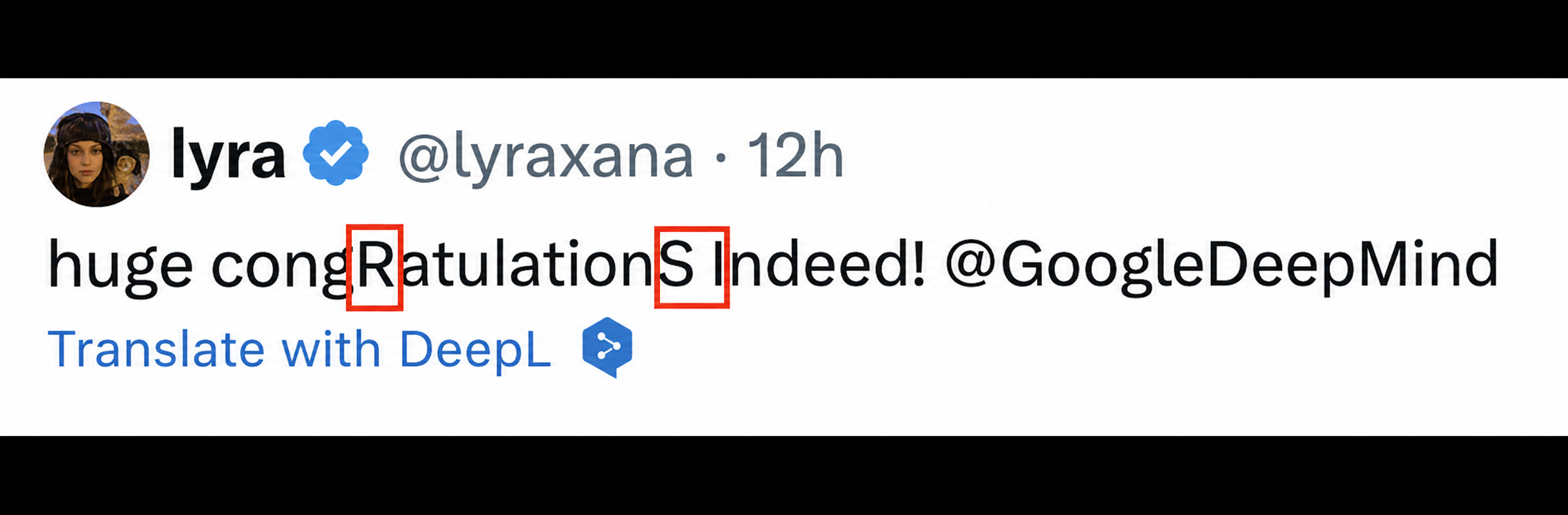
Here is the post that triggered this interpretation:
Caution is essential because RSI does not simply refer to AI helping humans program faster. In its strongest sense, it implies that a system cumulatively contributes to improving its own methods, training processes, or architecture, while greatly reducing or even eliminating human bottlenecks.
The thread does not prove that this transition has occurred. Above all, it documents how an ambiguous message can turn into a much more specific rumor about Gemini.
The actual starting point: congratulations from @lyraxana, not an RSI announcement
The direct source cited by @kimmonismus is a post published on September 11, 2026, by @lyraxana, an account that had 4,700 followers at the time. The message spread widely, with 2 million views, 2,700 likes, 152 reposts, 154 replies, and 173 quotes.
But its content is limited to a single sentence:
"huge congRatulationS Indeed! @GoogleDeepMind" @lyraxana
The capital letters in “congRatulationS” fueled the RSI interpretation, with the letters R and S highlighted in the screenshot shared by @kimmonismus. However, they do not turn the message into an explicit claim. @lyraxana mentions neither recursive self-improvement nor AGI, a Gemini model, a launch date, or any specific internal capability.
The screenshot used as the cover image is important for context, but also because it illustrates the limits of what was actually published: a congratulatory message followed by an interpretation.
This is where the story’s main leap occurs: @lyraxana posts an unspecified insinuation, then @kimmonismus places it within a specific rumor that RSI has already been achieved.
The second thread turned the insinuation into a viral narrative
The second thread provided with this story, published by @DanDr1s, played an important role in spreading the rumor. It spells out the supposed code in @lyraxana’s message: the unusual letters in “huge congRatulationS Indeed!” spell out R, S, I. His post exceeded 250,000 views, with more than 2,400 likes and around one hundred replies when we viewed it.
This thread provides no additional technical evidence, but it shows how the hypothesis crystallized. Several replies ask for “receipts,” challenge the “trusted leaker” designation, and, most importantly, raise a methodological question: at what threshold can we genuinely begin to speak of RSI?
@JulienDuquesne1 frames the issue in the most useful way for the analysis. Agents capable of conducting part of the research, writing code, or proposing experiments can greatly accelerate a lab without necessarily creating exponential recursive improvement dynamics. @upgradeoptimism adds another potential constraint: even with a highly advanced software loop, the physical world, chip supply, data centers, energy, and training cycles may remain bottlenecks.
The second thread therefore reinforces the importance of the topic without strengthening the evidence. Above all, it shows that the debate is no longer simply “is the leak true?” but “what observable capability would make it possible to say that an RSI loop truly exists?”
This is not exactly a case of fabricating information. @kimmonismus presents the topic as a rumor, not as official confirmation. But the phrase “more than just rumors” may give the impression that concrete, verifiable evidence supports this hypothesis. Yet @lyraxana’s post, taken in isolation, does not establish that.
The credibility attributed to @lyraxana is itself still an assertion
@kimmonismus claims that @lyraxana is part of a “reliable and huge” community of leakers. When asked directly by @rohit3a, who sees the message as a possible play on letters, he replies:
"dont know, they are pretty reliable." @kimmonismus
This response clarifies the nature of the reasoning: credibility rests largely on the trust placed in a supposedly well-informed source. Yet the available material contains no verifiable track record of accurate leaks attributed to @lyraxana, no corroborated inside information, and no document originating from Google.
Under the source post, @TzviGot rightly raises the question of how new the account is:
"An account from 4 months ago, verified this month, is spreading insider news about Google. Sounds legit 👌" @TzviGot
The screenshot shared by @TzviGot indicates that the @lyraxana account joined X in May 2026, has been verified since September 2026, changed its username in August, and connects via the North America App Store. These details do not prove that the account is deceptive. Nor do they demonstrate that it has access to confidential information about Google’s internal capabilities.

In the same thread, @HarshithLucky3 and @NoorStruggling say they are following the account while waiting for further posts. This attention shows that the message served as a signal. But public interest does not constitute a verification process.
At this stage, the chain of AI leaks rests on a stated reputation, not on independent evidence available in the discussion.
What @haider1 actually claimed: “early RSI,” not that RSI had been achieved
The thread contains a second important point of origin. Before @kimmonismus’s post, @haider1 had published, on September 6, 2026, a more limited analysis of the pace of Gemini releases. His post reached 130,000 views, with 661 likes, 10 reposts, 56 replies, and 6 quotes.
@haider1 writes that three new models had reportedly arrived within six weeks and sees this as a “sign of early RSI.” His full wording is significant:
"google is definitely using some form of RSI to progress this quickly" @haider1
This statement goes far, but it does not say that Google had “reached RSI” in the sense of a complete autonomous loop. It refers to “some form of RSI” and an early sign, in other words, a hypothesis about internal mechanisms for productivity, automation, or accelerated iteration.
The list provided by @lender980 illustrates the observed pace, with announcements ranging from Gemini 3.7 Flash on August 13 to Gemini 3.8 Flash, Gemini 3.8 Flash Cyber, WeatherNext 3, TimesFM-3, and other releases in late August and early September. This frequency may indeed suggest a faster development organization.
However, it may also be explained by several more conventional factors:
- closely related product variants released on different dates;
- more compute devoted to training and evaluations;
- more efficient teams and engineering pipelines;
- adjustments to reasoning, speed, or cost;
- a commercial strategy of accelerated releases.
@JakeKAllDay offers precisely such a conventional explanation for the move from Gemini 3.7 to 3.8:
"i like gemini but the jump from 3.7 vs 3.8 is mostly just a boost in juice/thinking effort. 3.8 med ~ equals 3.7 high on thinking effort. its partially masked by a ~10% speed up in tps." @JakeKAllDay
His argument does not demonstrate the absence of more advanced internal capabilities. It does, however, serve as a reminder that a release cadence, or a visible improvement in products, is not enough to diagnose recursive self-improvement.
Faster iteration is a possible operational signal, not proof of autonomous, closed-loop RSI.
@haider1’s paradox: he sees an early sign, then doubts that RSI has already been achieved
One of the most interesting aspects of the discussion is that @haider1 finds himself on both sides of the debate. On September 6, he interprets Gemini’s outputs as a sign of “early RSI.” On September 12, under @kimmonismus’s post, he logically challenges the idea that RSI has already been achieved, given the state of the public products.
"i actually said this a few days ago, but i'm still not sure how this is going to happen when google's models are still quite behind in coding so if google is claiming to have reached RSI, then openai and anthropic probably reached something similar way earlier" @haider1
This objection directly targets the gap between a spectacular internal hypothesis and users’ experience with Gemini coding models. If Google had indeed closed a highly effective recursive improvement loop, why would its public models not clearly dominate coding, reasoning, or agentic tasks compared with competitors often perceived as the leaders?
@kimmonismus responds with a strategic hypothesis:
"The question is whether Google might simply forgo offering state-of-the-art technology to consumers and invest everything in RSI instead." @kimmonismus
This is a possibility. Labs do not necessarily release their best capabilities, particularly for reasons of safety, cost, reliability, or competition. But in this thread, no evidence confirms that Google deliberately withheld functional state-of-the-art technology in favor of an internal RSI loop.
A gap between Google’s internal capabilities and its public products is conceivable, but here it remains a possible explanation, not an established fact.
Gemini products remain at the heart of the skeptics’ objection
Several participants do not reject the idea that Google conducts world-class research. Rather, they challenge the logical leap of turning this scientific strength into proof of RSI.
Under @lyraxana’s post, @DeepLearn007 describes this gap between research and product:
"Google possess amazing research - after all they pioneered Transformers with Self-Attention Mechanism and do much of the initial RL research that drives LLMs. But they have had a gap in translating the research into products. @demishassabis @lyraxana" @DeepLearn007
@VibeDevolli makes a similar criticism, based more directly on the use of public models:
"I want to believe, but knowing about their public models I am having a hard time doing so. :) We're a bit back in the Bard days vs the other high class models." @VibeDevolli
@kimmonismus replies without providing any new evidence:
"To be fair: GDM is still in the game" @kimmonismus
The response is reasonable, insofar as Google DeepMind remains a major AI player. However, it does not answer the question being asked: what public performance results, technical publications, or operational evidence would justify moving from a competitive company to one that has achieved RSI?
@Politas180 sums up this objection in a particularly clear sentence:
"If they’d actually closed the loop, Gemini would already be the model I leave running overnight. It’s not. Writing it in all caps doesn’t change that." @Politas180
This is a user’s judgment, not an academic benchmark. But it reflects a point shared by several participants: no public experience with Gemini currently provides clear evidence of a decisive lead consistent with recursive self-improvement already having been achieved.
The crucial technical distinction: research assistance versus end-to-end RSI
The strongest response in the thread comes from @MTorygreen. It denies neither Google’s advances nor AI’s potential impact on research and the training of future models. It simply asks the essential question: where does human intervention still occur?
"I’d be careful calling anything RSI until we know where the human bottleneck still sits. If the model is generating better experiments, improving code and helping design the next training run, that’s huge. But there’s still a big gap between that and a system recursively improving itself end to end." @MTorygreen
This distinction is essential when assessing rumors about Google DeepMind AGI.
A system can help to:
- generate research hypotheses;
- write or correct part of the training code;
- propose architectures or synthetic data;
- accelerate evaluations;
- help engineers choose the next training run.
All of this could significantly accelerate a lab’s work. But strong RSI would require more: results would need to be selected, validated, integrated, trained, and deployed with sufficiently limited human intervention for the system to improve its own capabilities cumulatively.
We would then need to know where validation, architectural decisions, safety checks, compute trade-offs, data access, and review of the results still take place. The thread provides no answers to these questions.
This is why @MTorygreen’s argument is the best-supported: the discussion suggests that automation may be possible, but does not document an end-to-end autonomous improvement loop.
A strategic narrative is no substitute for a technical demonstration
@kimmonismus supplements his post with references to Demis Hassabis, Sergey Brin, Reuters, and the strategic importance of RSI in the race for AGI. These points may explain why Google would be interested in such a technology. They do not demonstrate that it has been achieved.
The fact that Google DeepMind views AGI, research automation, or model improvement as priorities is consistent with the strategy of every major lab. Industrial ambition does not constitute technical validation.
@kimmonismus also says that he will cover the topic in his Superintelligence newsletter. The page describes itself as an AI briefing designed to help readers “win the future” and claims more than 160,000 daily subscribers. This positioning explains the interest in the topic, but provides no additional independent evidence regarding the rumor.
Why the rumor should nevertheless be taken seriously
The lack of public evidence does not mean the entire case is baseless. Two verifiable strategic signals explain why the rumor is finding particularly fertile ground today.
First, Google announced in August 2026 that Demis Hassabis was becoming Chair of Google DeepMind and Chief Scientist of Alphabet. The company states that this new role is intended to allow him to devote his “full attention” to shaping the future of AGI. The official announcement is available on the Google blog.
Second, Reuters reported on August 12, 2026, that Sergey Brin was pushing Google’s efforts toward recursive self-improvement as part of the reorganization of its AI operations. The report describes RSI as a sufficiently strategic focus to influence resource allocation and team structure. This does not confirm that a functional loop has been achieved. It does, however, confirm that the topic exists at the strategic level within Google, rather than solely in speculation on X. The Reuters report is available here.
The distinction is crucial. We have strong indications that Google wants to accelerate the self-improvement of its systems. We have no public evidence that it has crossed the threshold that social media is already calling “RSI.”
If Google truly has an RSI loop, the AI race changes in nature
This is where the story becomes more significant than a mere model rumor. A true RSI loop would not simply be “a smarter Gemini.” It would change the process that produces future Gemini models.
1. The pace of progress would itself become a competitive capability
Until now, the race between Google, OpenAI, and Anthropic has primarily been viewed through successive generations of models, benchmarks, and product launches. A self-improvement loop would shift the competition to a higher level: the speed at which a lab can improve its own research engine.
If a system helps identify useful experiments, writes an increasing share of the code, automatically analyzes failures, and proposes the next training run, the lab does not merely gain a few benchmark points. It shortens the cycle between generations. In this scenario, comparing public models at a given point in time becomes less informative than measuring the slope of internal progress.
This is also what makes the Gemini release cadence interesting without making it proof. Three closely spaced releases demonstrate nothing on their own. But if that cadence results from deep R&D automation, it becomes an indicator of a more structural advantage.
2. Google’s best model might never become a public product
The hypothesis put forward by @kimmonismus deserves to be examined: Google may be reserving its most advanced systems for internal research rather than immediately making them available to consumers.
This strategy would make economic sense. An internal model capable of improving data, training code, evaluations, or architectures may be more valuable as an R&D multiplier than as a chatbot released a few weeks earlier. The public product could therefore appear to lag behind while concealing a far more advanced internal infrastructure.
This would explain the thread’s central paradox, but only if independent evidence eventually confirms it. For now, it is a coherent hypothesis, not a proven explanation.
3. Compute would become research capital that improves its own returns
Even partial RSI could change the economics of compute. Today, more GPUs primarily make it possible to run more experiments, train larger models, or serve more users. In an automated improvement loop, some of the compute is also used to devise better ways of using future compute.
In other words, compute no longer funds only a model. It funds a process that seeks to make the next cycle more efficient. If this loop actually works, the advantage held by groups with the largest clusters, the best chips, ample energy, and vertical integration could grow.
Google is particularly well positioned in this area thanks to its TPUs, data centers, research teams, and ability to deploy results across a global infrastructure. This does not guarantee RSI. It explains why a breakthrough of this kind at DeepMind would have disproportionate industry-wide consequences.
4. OpenAI and Anthropic would be pushed toward greater secrecy and internal use
If one player proved that a system could materially improve the process used to build its successor, its competitors would have little incentive to respond solely with a public release. They too would seek to turn their best models into internal researchers, engineers, evaluators, and operators.
The visible consequence could be paradoxical: the more strategically important internal capabilities become, the less public models reveal about the full state of the race. Consumer benchmarks would remain important, but they would describe a product layer. The real competition would revolve around the quality of internal agents, experiment automation, compute efficiency, and the ability to turn an idea into a reliable training run.
That is why the objection “public Gemini is not number one, so Google cannot have RSI” is insufficient. But the opposite argument is just as weak: “Gemini is progressing rapidly, so Google has RSI.” Both conflate the observable product with the research infrastructure that produces it.
5. Safety and regulation should monitor a capability, not a term
The term RSI is too vague to serve on its own as a useful regulatory threshold. The right question is more concrete: which research tasks can a system perform without human intervention, at what success rate, and for how many consecutive cycles?
More relevant indicators would include the ability to modify training code, design and select experiments, diagnose results, propose a subsequent architecture, manage compute resources, and sustain measurable improvement over multiple iterations.
A laboratory could possess several components of this chain without having fully autonomous, end-to-end RSI. This intermediate zone is probably what matters most in the short term. It can already greatly accelerate progress, concentrate advantages among a few players, and complicate safety evaluations, without resembling the “exponential loop” often imagined when the term RSI circulates on X.
What readers should take away from this chain of posts
The Google DeepMind RSI rumor rests on three levels of information that should not be conflated:
- @lyraxana posted an ambiguous message of congratulations, without mentioning RSI or AGI.
- @haider1 had previously described Gemini’s pace as a “sign of early RSI,” meaning a limited hypothesis about possible accelerated automation.
- @kimmonismus connected these signals to a more specific rumor that Google DeepMind had achieved RSI, while acknowledging that it remains a rumor.
The thread leaves several questions unanswered:
- What did @lyraxana really mean?
- What verifiable evidence establishes her reliability as a source of AI leaks?
- What data would make it possible to distinguish an automated development pipeline from full recursive self-improvement?
- Do Google’s public models underestimate its actual internal capabilities, or do they more directly reflect the state of its systems?
- Does the pace of Gemini announcements stem from more autonomous AI, better teams, more compute, or a release strategy?
The most rigorous conclusion is therefore less dramatic than the initial rumor. Google may very well be accelerating its internal processes, using AI to improve code, experiments, and training, and investing heavily in AGI. But no public evidence in this thread proves that Google DeepMind has achieved full RSI, or even that @lyraxana’s message was specifically referring to this idea.